
Anytime an all-out conflict breaks out, a fog of war sets in. Naturally, the economy comes to a screeching halt at the onset of such a massive disruption. Confusion immediately takes hold of decision-makers, as one would expect. What is less clear, however, is when this confusion gives way to pragmatism or when decision-making resume and business begins to adapt.
To get a clearer sense of how founders have reacted in the early days of this all-out war, and how they are navigating ongoing uncertainty, we spoke with Smart ESA’s director, Karl Gedda. A French national who arrived in Beirut in November 2023, Karl is no stranger to the specter of instability that hangs over the Lebanese startup ecosystem. He brings decades of experience in innovation and acceleration, along with a firm conviction that nothing should stop an entrepreneur from moving forward.
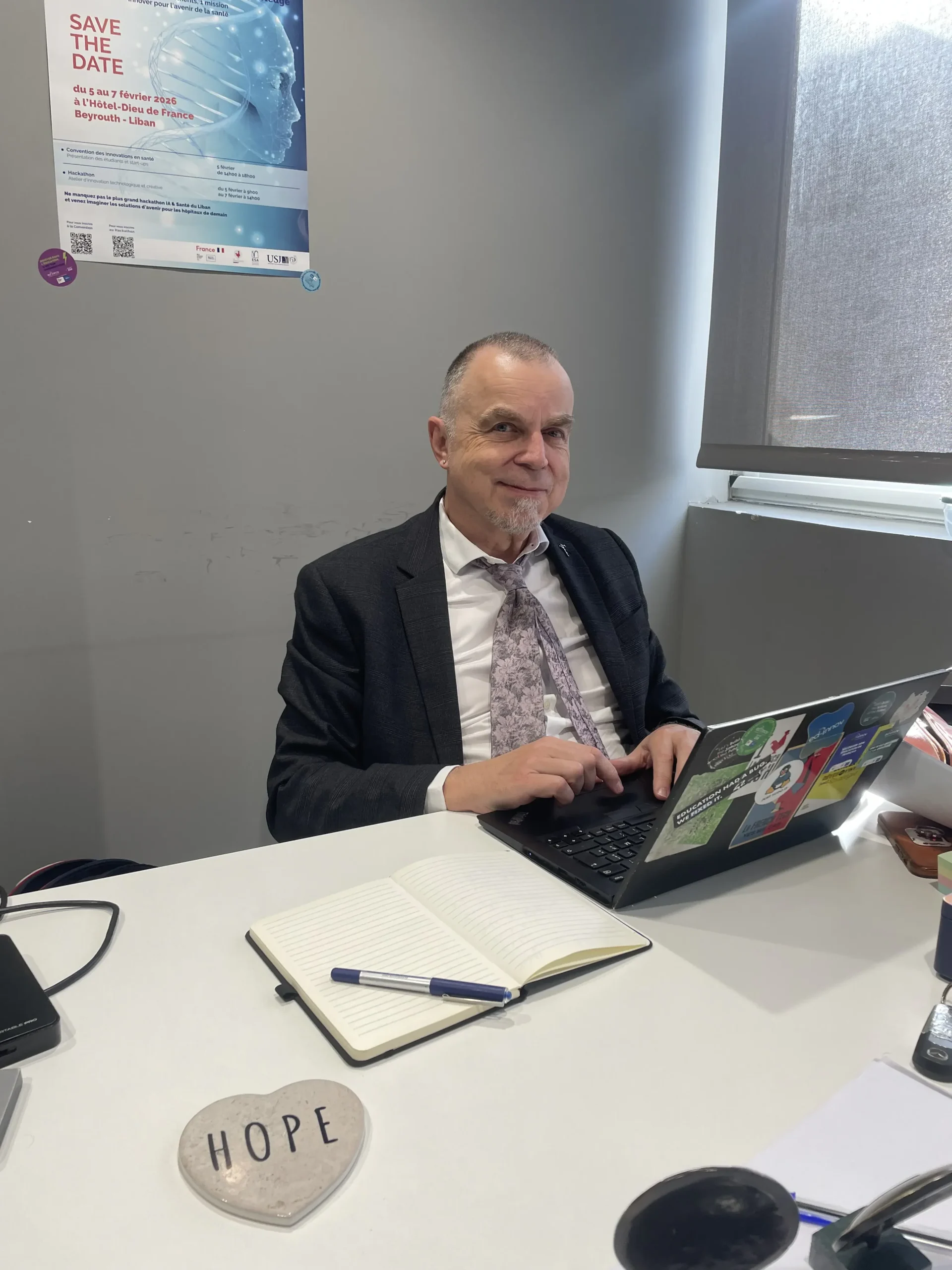
Karl embodies this mindset in more ways than one. Sitting across from him during the interview, one detail stood out: a heart-shaped rock on his desk with the word “HOPE” painted on it. Paired with a calm, reassuring smile, it reflects more than a symbolic gesture. It points to a grounded and deliberate belief that action must continue, and that focus should remain fixed on what lies ahead.
For readers who may not be familiar with Smart ESA, could you describe the role it plays in the ecosystem and what makes its positioning unique among its peers?
Smart ESA is the change and innovation accelerator of ESA Business School. This means that we operate both as an accelerator for entrepreneurs and as an organization that aims to bring change to society, the corporate world, and other institutions.
We act in two main ways. First, we accelerate entrepreneurs from the idea stage all the way to international development. Second, we aim to shake the existing system in Lebanon by encouraging innovation and new ways of thinking.
ESA itself has a specific positioning between France and Lebanon. It is very international and strongly connected to Europe. We leverage this position through access to talent at ESA, through conferences, visiting speakers, and the broader network we are building at the operational level.
We are closely connected to Europe first, but also to the GCC and other parts of the world. One of our main specificities is this openness to change, innovation, and international collaboration.
In that bridging role, do you also involve academia? Do you encourage researchers or academics to contribute ideas, write papers, or participate in the ecosystem’s thinking?
Yes, absolutely.
Our accelerator is physically located within ESA, in a small space at the center of the campus. We see the campus itself as a cluster. An innovation ecosystem needs visibility, collaboration, and knowledge production.
Visibility also comes through research and publications. The ESA research center produces work on topics such as female entrepreneurship and innovation in education.
The goal of that work is to explore how schools can evolve into “schools of the future.” One of our missions is to help bring change everywhere, not only in startups but also in institutions like education.
The way we do this is by helping schools work more like startups. They develop a vision, engage their local ecosystem, mobilize innovation actors, build a roadmap, and eventually work toward fundraising.
Are the schools currently raising funds themselves, or does Smart ESA do that on their behalf?
Both.
We allocate some funding directly to these projects, but schools are also expected to raise funds themselves. At the same time, we help mobilize donors and the private sector.
Private companies may also support schools through project-based funding.
What do these projects actually look like? Where does the funding go, and what kind of change are these initiatives trying to create?
The projects aim to adapt education to the realities of the 21st century.
We no longer need only bureaucratic systems. We need creative people and global citizens. Many projects focus on helping students develop those capabilities.
Some projects focus on sustainability, for example, guiding young people toward new approaches to agriculture or creating job opportunities outside major cities.
Others focus on robotics, AI, or global citizenship. One example is a program encouraging students to think about what it means to be an active citizen.
The idea is not to change the national curriculum directly but to transform how education happens around it. Schools might develop fab labs, interdisciplinary projects, or innovation spaces that complement traditional teaching.
Smart ESA has existed since 2017, and you became director in November 2023. What motivated you personally to take on this role, especially in Lebanon?
I have spent more than twenty years working in innovation.
At the time, we were working with companies, many of them young SMEs, that had previously relied on defense or space industry contracts during the Star Wars initiative under Ronald Reagan. When those contracts declined, these companies needed to find new markets and strategies.
Later I returned to France and helped open the innovation strategy practice for EY in southwest France. In 1999, we also built a startup studio.
My involvement with Smart ESA started when I brought some of the projects we were running in schools into the accelerator. I saw a lot of potential around ESA, especially because of its international network, its links to France and Europe, and connections like French Tech.
After several years, the accelerator needed to evolve. In innovation, if you want to remain disruptive or relevant, you have to rethink your strategy every five years. Revamping the program was therefore an interesting challenge.
Lebanon has entered another difficult period. From where you sit at Smart ESA, what have the past ten or twelve days looked like?
The first step was reconnecting with everyone to make sure they were safe.
We contacted founders and partners to check that they were okay and to see whether anyone needed help adjusting their strategy. When a crisis hits this strongly, the first instinct is to shelter.
For many entrepreneurs, this means reviewing expenses and preserving resources. We also checked on the twenty schools we work with. Some had to relocate, for example from Nabatieh or parts of the Bekaa.
Our role is to help them think about the long term and, if necessary, redesign their strategies. At the same time, we continue acting as a bridge, providing support, maintaining connections, and offering some sense of direction during uncertain times.
Do crises like this weaken an ecosystem, or do they reshape it?
It depends.
In some ways, it weakens the ecosystem. International partnerships are affected. For example, we are currently working with Iraq, but some experts in Europe are reluctant to travel to places like Baghdad because of security concerns.
More broadly, global priorities shift. Energy crises, geopolitical changes, and other factors mean that countries like Lebanon or Iraq are no longer top priorities for some international partners.
Lebanon’s image abroad also deteriorates during conflicts. It becomes harder to convince partners in places like Spain, France, or the Baltic countries to send entrepreneurs here or to see Lebanon as a gateway to the MENA region.
But crises also make entrepreneurs stronger. Those who survive become more agile, and agility is essential for entrepreneurship.
Why is it important for you to reconnect with founders during moments like this?
Entrepreneurs make many decisions alone. It helps to talk with someone who understands the situation and can exchange ideas with them.
I have been an entrepreneur myself several times, so I understand that experience.
Entrepreneurs benefit from speaking with peers or mentors who have also built companies, rather than only listening to lectures or theoretical advice.
Having someone who has faced similar challenges makes those conversations more meaningful.
What surprised you most about how founders have reacted since the war began?
Nothing really surprised me. Perhaps because this is the second war I have experienced as director of Smart ESA.
I do not see founders as depressed or discouraged. Instead, they approach the situation pragmatically. They treat it as a temporary interruption.
The question they ask themselves is: how long will this last, and how can we preserve resources so that we can start again once conditions improve?
If you had to choose, would you describe founders right now as simply trying to survive or as eager to get back to work?
They are eager to get back to work.
They treat the crisis as a parenthesis. The key question is how long that parenthesis will last and how they can protect their resources during that time.
Many are still maintaining connections with international partners and continuing certain activities remotely.
Do younger founders react differently from more experienced entrepreneurs? Does age play a role in how people respond to these situations?
Entrepreneurs are generally young in spirit, and most of them are young anyway.
In practice, what I see is founders continuing to plan ahead. For example, we are currently preparing soft-landing opportunities in Europe for some founders later this year.
We are discussing sending some of them to Station F in Paris and helping others connect with European funding programs.
So rather than stopping completely, many founders are planning for the future while being careful not to lose resources in the present.
In a moment like this, what role should an accelerator play? Is it about motivating founders, or is resilience something entrepreneurs must bring themselves?
Entrepreneurship is always risky. Startups fail everywhere, not only in Lebanon.
The main reasons are usually internal conflicts between founders or poor strategic positioning. Another frequent issue is financing, specifically not anticipating how slowly markets sometimes adopt new products.
In Lebanon, we have both strong entrepreneurs and weaker ones. Some people believe entrepreneurship is mainly about pitching or presenting ideas attractively. But without a strong strategy and the ability to listen to customers, that approach does not work.
During the first week of a crisis, there is usually a moment of shock. People pause and try to understand the situation.
But after that initial period, activity resumes. Schools reopen, businesses adapt, and entrepreneurs return to work while adjusting their strategies.
Was there any specific example in the past week that stood out to you?
Many founders responded very well. I cannot single anyone out.
One important point is that after taking care of their own immediate situation, entrepreneurs need to reconnect with their customers. During crises, people become more emotional and more open to communication.
Those moments can actually strengthen relationships between companies and their clients.
So it is not necessarily surprising, it is simply what you expect from entrepreneurs?
Yes.
Entrepreneurs face different types of stress depending on where they are. In Europe, people might deal with transportation strikes or temporary infrastructure disruptions. Here the challenges are different.
But regardless of the context, entrepreneurs should not collapse. Their role is to continue moving forward.
Our role is to stay hopeful and to show that there is still light ahead.
Given the current situation, what opportunities should founders be looking toward?
They should look toward reconstruction.
After a war, significant resources usually arrive for rebuilding in sectors such as health, education, and green development.
Entrepreneurs should think about how to survive the crisis and prepare for the opportunities that may emerge afterward.
Crises and opportunities are often two sides of the same coin.
If you were advising a young Lebanese founder right now, what would you tell them?
They should protect their wings until the sky clears.
In the meantime, they can prepare their next flight by mapping where they want to go once conditions improve.
Looking beyond the war, what structural changes would help Lebanese founders succeed in the long term?
Innovation in Lebanon is still not large enough.
Funding is one major issue. Another is visibility. There is not enough media coverage of what startups are doing.
Even when innovations are not revolutionary, they still matter. Take Toters, for example. The concept already existed elsewhere, but it was successfully adapted to the Lebanese context.
Beyond visibility and funding, we also need greater technological integration and stronger collaboration with the corporate sector.
In Europe, large corporations only began seriously collaborating with startups around 2019. Lebanon will also need time to develop that kind of cooperation.
Do you think legislation or regulation could help facilitate that collaboration between startups, corporations, and investors?
Starting a company in Lebanon is not impossible. The bigger issue is that administrative processes can be slow because the state itself is not always functioning normally.
Some legal frameworks are also missing, particularly those that support social entrepreneurship or provide tax incentives for investing in startups.
More people also need to become business angels. Investment in startups can produce returns comparable to other sectors if done strategically.
But it requires training, visibility, and a better understanding of how startups operate.
Lebanon can also function as a testing ground. Startups can experiment locally before expanding internationally. Just think of a sandbox. Startups can play around before launching internationally.
For this reason, stronger collaboration between corporations and startups is important.
When you mention corporations, are you referring mainly to research and development activities?
R&D can exist within corporations, but it also exists within universities.
Universities play a different role: they help transform technologies developed in laboratories into startups.
You have worked in California, France, and other international environments. Given the concerns about brain drain in Lebanon, what is your perception of the talent that remains here?
There is talent in Lebanon.
Sometimes the narrative exaggerates how much talent exists, which can lead to unrealistic expectations. When I first arrived, I may have believed that narrative too strongly.
The talent exists, but it is not always organized. Sometimes it remains too academic and not sufficiently connected to practical innovation.
My main observation is that the world has changed, but Lebanon has not adapted as quickly.
Large corporations in Europe began transforming around 2019, recognizing that they needed to collaborate with startups. They started seeking new ideas not only from internal R&D teams but also from external entrepreneurs.
Today’s economy is increasingly entrepreneurial.
Lebanese people are very strong in business negotiation and management. The next step is strengthening innovation.
If Lebanon wants to remain an economic lighthouse in the region, it will need to build a stronger innovation culture and encourage more technology-driven entrepreneurship.